
How to Write Your Wedding Vows: Tips and Examples From an Ottawa Officiant
Few things can make a confident adult stare at a blank page quite like the words “write your own vows.”
You love this person. You know exactly how you feel. And yet somehow, the only thing you’ve written so far is “Dear,” and then you’ve gone to check the fridge.
Take a breath. Your vows don’t need to be poetry, and you don’t need to be a writer. They just need to sound like you, talking to the person you love. As natural-born storytellers, this is our favourite part of a ceremony, so here’s our step-by-step approach to writing vows you’ll be proud to say out loud.
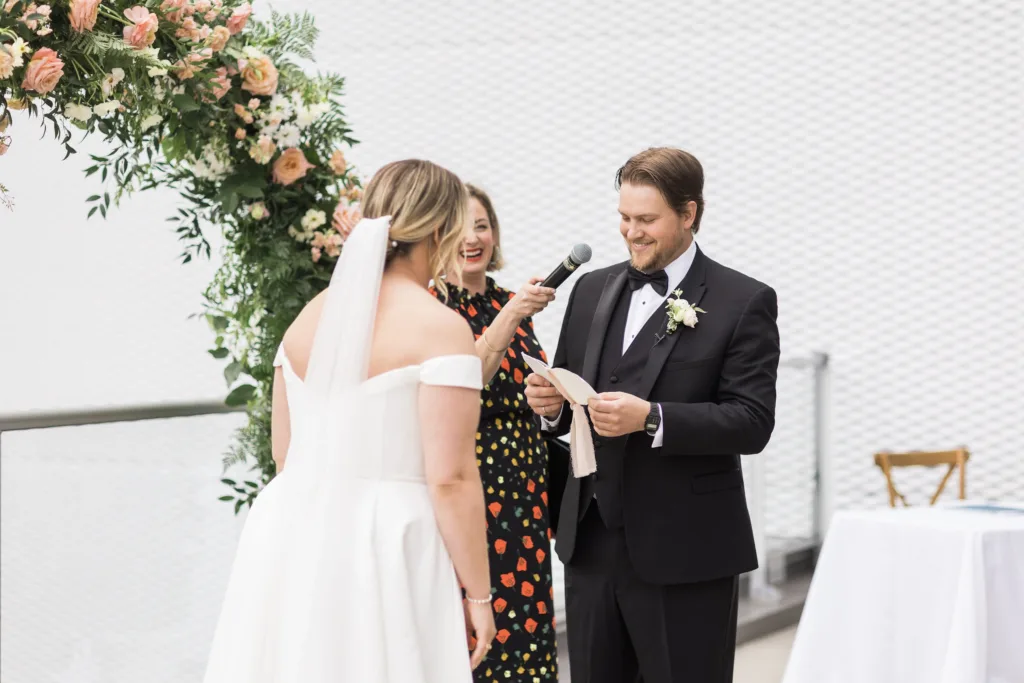
Step 1: Start with a conversation, not a draft
Before anyone writes a word, agree on the basics together:
- Length: One to two minutes each is a lovely target. That’s roughly 150 to 250 words.
- Tone: Funny, romantic, or a mix of both? You don’t want one partner delivering a stand-up set while the other is reading a sonnet.
- Sharing: Will you keep your vows a surprise, or read them to each other first? Either works. Or ask your officiant to read both and quietly confirm they match.
Step 2: Collect your raw material
Don’t try to write yet. Just answer these questions in your phone’s notes app, in whatever messy words come out:
- When did you first know this person was the one?
- What do they do that nobody else notices?
- When did they show up for you in a hard moment?
- What makes you laugh together, even when you shouldn’t?
- What does an ordinary Tuesday with them look like, and why do you love it?
- What are you looking forward to most about your future together?
Look for the specific details. “You’re so thoughtful” is sweet. “You warm up my car on February mornings before I’ve even found my boots” is something only you could say, and any Ottawa guest will feel it.
Step 3: Use a simple structure
Most great vows follow the same three-part shape:
- Your love: Who they are to you, and what you love about them.
- Your story: One specific memory or detail that shows it.
- Your promises: What you’ll do, for the rest of your life.
That’s it. Three small sections, and you’ve got vows.
Step 4: Make promises you can actually picture
Promises are the heart of your vows, and the best ones mix the big with the small. Pair something profound with something beautifully ordinary:
“I promise to stand beside you through every hard day. I also promise to stop saying ‘just five more minutes’ at the hardware store.”
The laugh makes the serious promise land even harder. That balance of heart and humour is what makes a ceremony feel real.
Wedding vow examples to get you started
Borrow the shape of these, then fill them with your own life.
Short and sweet
“You are my calm, my favourite person, and my best idea. I promise to listen, to choose you every day, and to always save you the last bite. I can’t wait for the rest of our life.”
Light and funny
“You’ve seen me with the flu. You’ve seen me try to assemble furniture. And you’re still here, in front of all these people, which I’m taking as a legally binding sign of love. I promise to laugh with you, to read the instructions next time, and to love you louder than I snore.”
Heartfelt
“Before you, I thought home was a place. Then you sat beside me in the hospital waiting room and told me we’d figure it out together, and we did. I promise to be that person for you. In the easy years and the hard ones, wherever we go, you are my home.”
Bilingual
“You taught me that love doesn’t need perfect grammar. Je te promets d’être là, dans les beaux jours comme dans les plus difficiles. I promise to keep trying, keep laughing, and keep choosing you. Pour toujours.”
Tips for bilingual vows
Ottawa and Gatineau are full of couples and families who live in two languages, and vows are a beautiful place to honour that.
- Speak from the heart first. Use whichever language your feelings come in. Then add the other where it feels natural.
- Don’t translate every line. It doubles your length and loses energy. Switch languages for key promises instead.
- Think about your guests. If some won’t follow one language, your officiant can help frame the moment so that everyone feels included.
- Practise out loud. Especially if you’re speaking your second language. Your partner will love the effort, accent and all.
What to leave out
- Anything your grandmother shouldn’t hear. The honeymoon jokes can wait for the speeches.
- Inside jokes nobody can follow. One is charming. Five leave your guests behind.
- Exes. Just no.
- Teasing with a sting. Your partner should feel celebrated, not roasted.
Getting ready for the big moment
Read your vows out loud at least three times, ideally to the mirror or the dog. If you stumble over a line, rewrite it the way you’d really say it.
Then copy them out by hand or print them onto a nice card. Your phone can light up with notifications mid-promise, and it doesn’t look nearly as lovely in your photos. Give a copy to your officiant as a backup, too. And if you tear up? Good. Take a breath, take your partner’s hand, and keep going. Nobody in that room is judging you. Curious how it all comes together? Watch some real Ottawa wedding ceremony videos.
One legal note
Your personal vows are the romantic part, but they don’t replace the legal part. The Marriage Act requires each of you to make a short declaration in front of your officiant and two witnesses. Your officiant will include this in your ceremony, so all you have to do is repeat after them and try not to cry. Still choosing your officiant? Here are the questions to ask a wedding officiant before you book.
Need a hand finding the words?
Vow guidance is part of every Merry Fairy wedding ceremony. We’ll help you shape your stories into promises that sound exactly like you, in English, French or both, and we’ll build a warm, personal ceremony around them. Having a friend officiate instead? Here is how a friend can officiate your wedding in Ontario, and our ceremony coaching has you covered.